 |


|
|
|
Primitive hominoids |
|
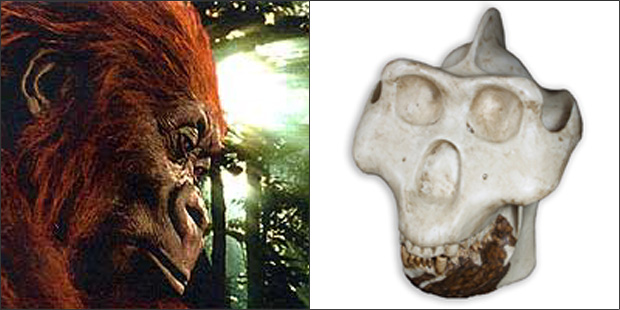
Gigantopithecus blacki Standing an enormous three metres in height, Gigantopithecus may be the largest primate ever to have lived. The name means "Gigantic Ape of Black" after the twentieth century archaeologist, Davidson Black, and it lived somewhere between 6.3 million to 200,000 years ago, a relative of Ramapithecus or Sivapithecus. According to 2004 studies it was not related to orang-utans other than through their joint African origins. Geographical distribution is sketchy, since the majority of remains are from one site: Liucheng Cave in Liuzhou, China. There have been other finds in Vietnam and in China, so that its range can clearly be defined as South East Asia. A separate species, Gigantopithecus giganteus, existed in Northern India, but this specimen predates Gigantopithecus blacki by about five million years, and was either a sister species which died out much earlier, or a direct ancestor. Either way, it clearly demonstrates the eastwards migration of hominoids from Africa. In 2014 a further blacki partial specimen was found in Indonesia. Gigantopithecus had a broad, short face with a massive jaw, and teeth designed for stripping bamboo shoots in the dense forests of its habitat. Like other big herbivores, Gigantopithecus was probably a slow mover. But it had little need for speed. Its feeding habits required it to do little more than move from place to place as it systematically stripped vegetation from its surroundings. Homo erectus may have hunted and eaten juvenile or injured Gigantopithecus, but it is unlikely that they would have taken on an enormous adult. Gigantopithecus males were much larger than the females, suggesting that there may have been strong competition for mates amongst males. Extinction probably came from a lessening of resources. Gigantopithecus was in direct competition for foodstocks with the giant panda, and the arrival of Homo erectus would have seen even more bamboo resources depleted. If the back-up source of fruit was also being harvested by Homo erectus, then one of the periodic die-offs of bamboo which occur would have tipped the balance against Gigantopithecus.
|
|
Skull image © Skulls Unlimited Intl. Core text copyright © BBC and the History Files. An original feature for the History Files. Go back return home, or go to Hominid Chronology Part 1. |

