 |
|
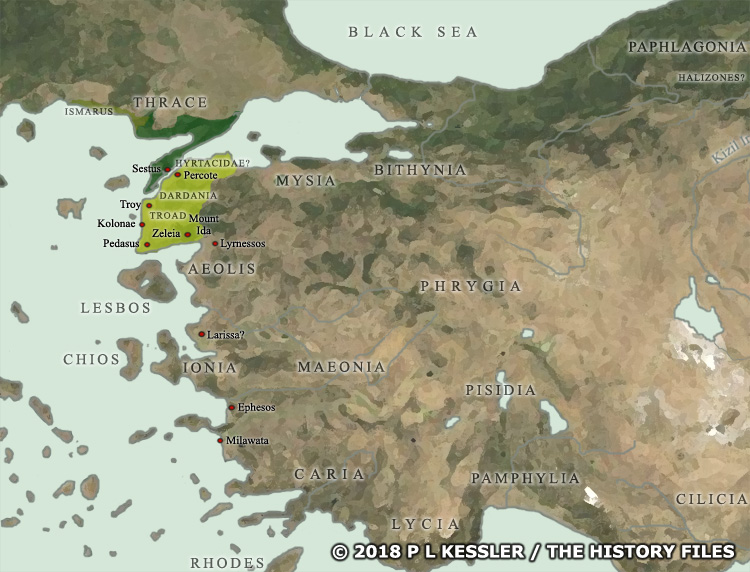
Map of the Trojan War states c.1200 BC |
|
The Bronze Age collapse at the end of the thirteenth century BC saw a great many changes in the ancient world. Many second millennium states disappeared entirely. Others underwent a process of transformation which effectively turned them into new states, and some regions in western and central Anatolia remained abandoned for decades. Until the collapse, the Hittites had been almost the only ones to record the names of the various Anatolian states, using their language to interpret those names, although many of the inhabitants of those states spoke a similar language anyway. During and after the collapse, written records became very sparse. Mycenaean Greeks were migrating into Anatolia, often destroying the established local political structure, and bringing with them their own language and oral traditions. Local names which may first have been written down by them centuries later underwent a degree of transformation in that time. Although it seems that Greek settlers had been arriving on the western shores of Anatolia for a couple of centuries, the Trojan War around 1183 BC was the high-point of their involvement in 'Hittite' Anatolia. Following the destruction of what seems to have been the last organised Anatolian opposition (Troy), Greek settlement of western Anatolia appears to have been largely unopposed, although the available historical data is extremely sparse. Troy's various regional allies at the time of the Trojan War are shown here, many of which are only mentioned in later works by Homer, Herodotus, and other Greek chroniclers. Naturally, these works often use names which were familiar to their audience, but which may have been very different in the twelfth century BC. Nevertheless, the traditional names are used here. Many states, especially those outside the Troad, are historically attested, even if only poorly at first. Main sources A clickable version of this map is available for desktop displays. To select a state for further information, click on its name.
Map navigation: |
|
Original text and map copyright © P L Kessler
and the History Files. An original feature for the History Files. |


