 |
|
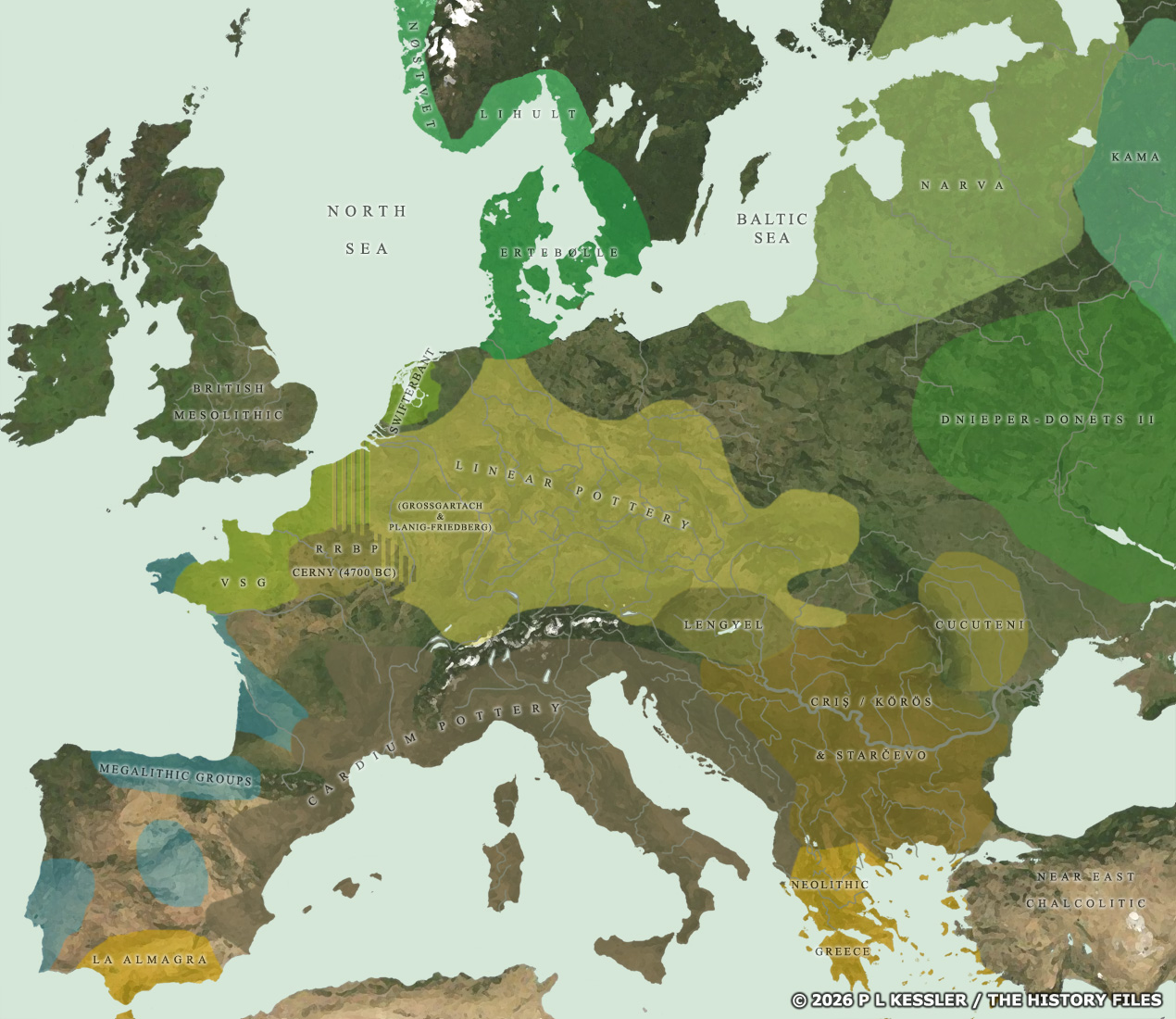
Early Neolithic Cultures c.5000-4500 BC |
|
Western and Central Europe of the early Neolithic between about 5000-4500 BC experienced a series of distinct cultural zones which had been created by the westwards expansion of Neolithic farming practices which originally had been brought into Europe by migrating Anatolian farmers. Widespread cultures such as the Cardium Pottery and Linear Pottery (LBK) were giving way to regionalised successors such as the Stentinello and La Hoguette (in the case of the Cardium), and the Grossgartach, Planig-Friedberg, Rössen, RRBP, and Lengyel (for the LBK). The La Almagra was early and long-lasting as an expression of early farmer migration into southern Iberia. The region experienced a major transitional phase from the early Neolithic to the middle Neolithic, a transition which was characterised by flourishing agrarian societies, the rise of complex regional cultures, and the very beginnings of metallurgy in the Balkans. Sedentary life replaced nomadic hunting and gathering, leading to the formation of stable, long-term community settlements. The people of Europe's various Neolithic cultures built massive rectangular timber-and-thatch longhouses which could accommodate extended families and provide communal storage. Communities largely relied upon domesticated livestock such as cattle, pigs, sheep, and goats, and cultivated crops which included emmer wheat, einkorn wheat, and barley. Whilst south-eastern and Central Europe were soon being densely farmed, much of Atlantic and Northern Europe remained inhabited by indigenous Mesolithic hunter-gatherer groups which gradually interacted with or absorbed the expanding farming frontier. The Swifterbant was one such culture, taking on farming aspects between about 5600-5000 BC but never fully. Hunting and foraging remained alternative options. The Ertebølle is another such fringe Mesolithic group which gradually adopted elements of the farming revolution. A clickable version of this map is available for desktop displays. To select a territory for further information, click anywhere within its borders.
Map navigation: |
|
Original text and map copyright © P L Kessler and the History Files. An original feature for the History Files. Go back or return home. |

