
If you are interested in editing or researching for a specific period or region within the History Files, then please
Contact us.
Post-Roman Britain
Early Independent Britain AD 400-425
by Peter Kessler, 1999. Updated 8 September 2007
The
well-known date of Britain's final official break from Rome is AD 410, but by that stage
Roman Britannia had mostly been fighting its own battles for nearly thirty years with only
occasional support from Rome. It was forced
to look after its own interests in the face of increasing barbarian raids; from the Picts to the north, the Scotti and Irish to the west, and from various
Teutonic tribes to the south and east.
There had been frequent barbarian raids throughout the fourth century in
Britain. The Barbarian
Conspiracy in 367 was a three-fold attack by Teutons from across the North Sea, and Picts
and Scotti from the north and west.
Magnus Maximus
The next crisis faced by Britain came in 383, when the
military commander, Magnus
Maximus, realised that Roman power in the region was becoming increasingly
toothless, and made his own claim to
imperial power, supported by the army. His death in 388 deprived the island of the
greatest part of its military strength, although the reorganisations usually attributed to
him shored up the north and western coasts of Britain. However, there
appears to have been almost continual warfare against the Picts during this
period.
In about 398, Britain apparently had to be rescued from her barbarian foes, this time by the
most powerful general of the Western Roman Empire, Stilicho. Stilicho's
intervention was the last occasion on which a major expedition was mounted
against the enemies of Britain.
Soon after the situation had been retrieved, Roman forces on the island were further reduced to serve Italy against the invading Goths. By 406, Britain's military
strength had been largely drained away, and the following decade completed the process.
In 406 a vast army of barbarians crossed the frozen Rhine and began
advancing westwards towards the Channel coast. It began to appear as though Britain might
be invaded.
Constantine III
Earlier in the same year, the army in Britain had already elevated an unknown soldier, Marcus,
to supreme power. He did not last long, being supplanted at the time of the
barbarian advance through Gaul by Gratian, an urban magistrate (magistratum).
Gratian survived only four months, and the army's next choice fell on a
soldier, Constantine, who challenged Roman authority in Gaul, creating a prefecture at Arles from which to rule as Emperor Constantine III.
Constantine had, in 407 removed at least something of Britain's remaining trained forces only to be killed in 411 at Arles. The troops never returned but instead may have largely
settled in Armorica, paving the way for a later British migration there.
In 408/409,
Britain was subjected to a largescale barbarian invasion, probably by Saxons, with Anglian
support.
The British civitates - the urban centres - managed to defend themselves and by
409 had quelled the attack, although details of how they did this are not available. It is
possible that many of the surviving defeated Saxons and Angles were employed as foederati
- mercenary troops - to garrison the Saxon Shore (the east coast) and protect it from
further attacks. Although this was established Roman practise, and undoubtedly in use
before this time, this action would help to explain the large number of Teutonic sites
along Britain's east coast that are evident from before the Adventus Saxonum in 450.
In 410, the feeble emperor Honorius informed the internal government of Britain
that it would have to look after its own defence, implying that this would be a permanent
arrangement. During what was either a revolt of peasants and slaves in Britain in 409 to
mirror either the popular uprising of the oppressed classes in Armorica (Brittany), or
at the tail
end of the barbarian invasion, the Romano-British governor had appealed for imperial help.
In the face of this abandonment by Rome, the defence of Britain was left to the western
and northern kingdoms and whatever remained of the central government, essentially
operating under a traditional
Celtic High King, who may well have used the title Emperor of Britain while it still meant
anything.
Theoretically, Vortigern could have been the first of these, with Ambrosius
Aurelianus, and Arthur following them (Uther Pendragon is harder to pin down, but would
have ruled between Ambrosius and Arthur, unless, of course, he was in reality the same
person as Ambrosius, an argument not within the scope of this feature).
Border client kingdoms
Welsh tradition has long held that Magnus Maximus arranged the island's defences
before making his expedition abroad to claim the Imperial title. Other sources attribute
some of the changes to Vortigern,
so a combination of the two is highly likely. Magnus Maximus, though, began the
work, and seems likely to have made the biggest changes. What he did was to arrange large
defensive areas that could be governed by client tribes or native Roman officers.
All of
these were set up in the militarised zones, in the west and north, areas that had never
been fully Romanised and had been under military control through several chains of forts.
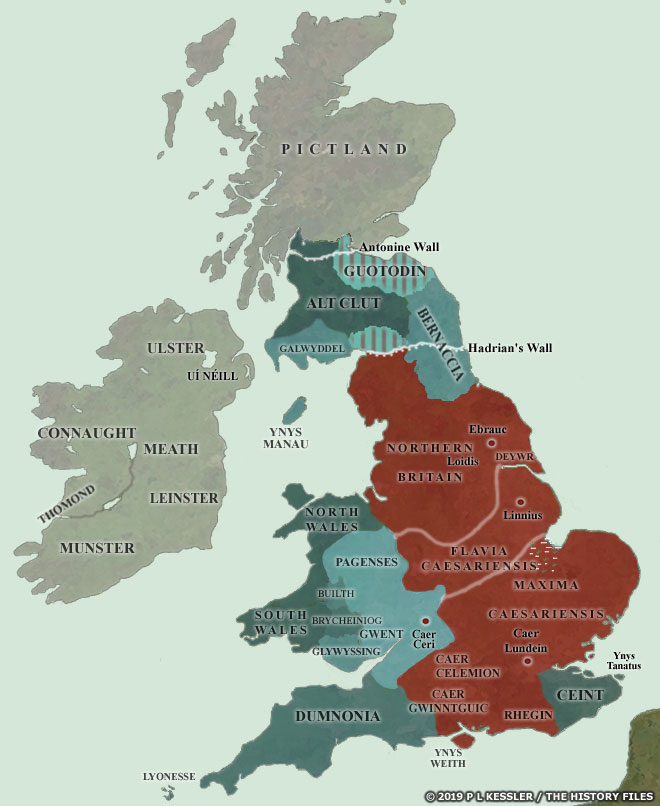
The borders shown in the map below are mostly conjectural, but are based on later kingdoms
that emerged in these areas, through the inevitable fragmentation that occurred when
Celtic tradition demanded an equal distribution of land between surviving sons.
The south and east, areas far more greatly Romanised, came under the island's
central administration, for as long as it lasted.
This explains the proliferation of early independent Celtic kingdoms in the west and
north, while the heart of the Celtic Lloegr (ie. England) was much slower to fragment,
and perhaps because of that, was a much easier area from which Angles and Saxons
could grab territory.
However, kingdoms did emerge in the south and east, mostly towards the end of the fifth
century, and some of these left evidence of their survival, if not their names. (details
of these can be accessed from the next map in the series, The Island of Britain).
Romans were still being buried in London in the early fifth century
To select a territorium for a
description, click anywhere within its borders.
Ceretic Guletic, King of Alt Clut
Ceretic was the first king of Alt Clut (Strathcluaide) in this period,
and perhaps the first to be recognised by Britain's administration.
However, it seems certain that the kingdom was created in AD 148 by a
descendant of the last free High King of Britain, Caratacus. This was one
of the 'four kingdoms of (Lowland) Scotland' which held the territory
between 'proper' Roman Britain and the Pictish north. Most of them may
have maintained Roman client kingdom status for much of their existence
before 409.
Ceretic ruled his territorium from the place from which the kingdom took its name, a rocky promontory overlooking the Clyde. This capital became known as the Fort of the Britons, Dun Breaton (and later, Dunbarton).
Policing the western half of the Antonine Wall as a probably Roman client chieftain, Ceretic and his
descendants forged a strong but poorly recorded kingdom which, alone amongst the British
kingdoms outside Cymru, was never successfully conquered by the English. Instead,
after becoming a Pictish/Scottish satellite state in the ninth century, it
was fully merged within Scotland in the eleventh century.
Although Cunedda Wledig originated from this region if, as per
tradition, he was
moved by Magnus Maximus, he would have been in North Wales by 383.
The first known king of Goutodin is Lot Lwyddog, who reigned around
the end of the fifth century - before that there seems to be little
information on this northern tribe, and it is possible that the
Votadini chieftains, late in accepting the benefits of Roman
civilisation, were also late to unite and form a single political
entity.
Nora Chadwick's
The Celts theorises that Coel Hen and his descendants guarded this eastern end of
the Antonine Wall, in the buffer zone between that and Hadrian's Wall. Could Coel Hen have
commanded, as governor of the militarised zone of north Britain, the Votadini chieftains,
perhaps dealing directly with one high-chieftain? It seems highly plausible that after the
death of Ceneu ap Coel, Coel Hen's son, the Votadini, or Goutodin, would seek to emulate
the kingdoms being formed by his sons to the south. As a kingdom, Goutodin may
well have been born only by around 470, with Lot Lwyddog as its first ruler.
Unfortunately, the kingdom never had a stable line of succession, and
after the rulers (a king and a probable sub-king) were defeated at Catreath
in around 597, as described in the Gododdin, the Kingdom of
Goutodin was fatally weakened, and its remnants fell in 638 to the Angles of Bernicia.
The capital of Late Roman Britain in the north was Eboracum, later Ebrauc to the British,
Eorforwic to the English, and contorted into York by the Danes. This was the civitas
capital of the Brigantian Britons, who as pre-Roman Celts had ruled a huge swathe of
central northern England for some centuries. Archaeological evidence points to a period of
rebuilding in York at the start of the fifth century, when Coel Hen was at the height of his
governorship of the region. But, formed partly it seems from the Roman military district of Valentia, the Kingdom of Northern Britain
covered the whole of the Roman militarised zone from a line close to the Humber to
Hadrian's Wall and a lesser sphere of influence for some distance beyond it (perhaps
including the Votadini, as mentioned above).
Quite possibly appointed to his position by the departing Magnus Maximus, Coel
Hen was probably the last Roman-style dux brittanniarum, and would have ruled in a very Romanised
way. He held the north in a strong protective grip, and guaranteed that he and his
immediate descendants had little trouble from the Picts to the north. Unfortunately, his
descendants divided what was a very strong single political entity into a patchwork of
small kingdoms that fell one by one to the Angles.
The ninth century Historia Brittonum (The History of Britain, attributed
to a certain Nennius) is the earliest source for
Welsh history outside the Lives of the Saints, and it records that a certain
Cunedag (Welsh Cunedda), together with eight of his sons and one grandson, came from
Manau Goutodin (near the Firth of
Forth) a hundred and forty-six years before the reign of Maelgwyn, king of Gwynedd, and
that they had expelled the Irish forever from those lands.
This was the primary reason behind the decision to invite
Cunedda to become "King of North Wales" as he was styled (although this
appellation probably came much later, after his lifetime - he was never referred to as rex,
"king", in the Historia). Maelgwyn's reign began in 517, so this places
Cunedda's migration at 371, which seems a little early. Magnus Maximus is usually credited
with reorganising the country's defences leading up to his departure in 383, and it is
this date that is more traditionally linked with Cunedda, so something between 380 - 383
seems more acceptable for the move.
Cunedda and his people quickly settled in Gwynedd, carrying
out their task of expelling the Irish invaders who had begun to settle there. The process
of "freeing" North Wales seems to have lasted a few years, until the only Irish
stronghold remained on Ynys Mon (the Isle of Anglesey). Signs of Irish settlement in the
area can still be found opposite Irish Leinster, in the probable origin
of the Lleyn peninsula - the long "pig's ear" - as its name may contain Irish Laigin,
"Leinstermen".
Antonius,
also known to Welsh tradition as Anawn Dynod, was another son of Magnus Maximus, set up
in his own territorium by his father or shortly after his departure. The
positioning of Demetia, kingdom of the Demetae Britons, meant that it could protect the
south west coastline from Irish raids.
The South Wales
region soon crystallised into the kingdom of Demetia, later Dyfed. and was made up of two
main regions. The larger part of the territory was Dyfed itself, and Ystrad Towy (or Towi)
made up the eastern third or so. This was conquered in around 690 by Ceredigion, but Wales was united under
the kings of Gwynedd in the ninth century, and Dyfed came to form the heart
of a united South Wales after that, continuing through Deheubarth. The later
kingdom of Brycheiniog also seems
to have (at least partially) formed part of the South Wales territory.
As a complete opposite of the process going on in North
Wales at the same time, Irish settlement in Demetia was actively encouraged, in the form
of inviting the Irish Deisi tribe to settle there. They seem to have been brought in to
act as foederati on the west coast, keeping the British shores clear of Irish
raiders, an apparently successful policy. In the region, many Irish words are mixed into
the regional dialect, and there is a considerable spread of memorial stones pointing to
Irish influence. The incidence of Ogham (Irish) symbols, highest in the modern county of
Dyfed, is a crude guide to the settlement of the Deisi, and after the British line of
rulers had died out, the Deisi were best placed, through intermarriage, to assumed
the legitimate rule of Dyfed.
Although many later Welsh kings claimed descent from Magnus Maximus
in order to legitimise and enhance their own status, Owain Finddu
has one of the better claims, and his territory seems to have been
created to plug a gap between South Wales and Ewyas.
The
kingdom of Cernyw emerged from this with Owain's son, and was
renamed after Owain's great-grandson as Glywyssing. Even later, in
the tenth century, it was again renamed after one of its most
powerful late rulers as Morgannwg, and is remembered as today's
Glamorgan region.
Probably the great-grandnephew of Eudaf Hen (the Old), former king of Ewyas, Meirchion son of Gwrgant seems to have been
the last king of Ewyas. The kingdom was without a ruler in around 430 so
that Vortigern was able to give it to his
eldest son, Vortimer. Vortimer appears to have been able to claim the area as his
inheritance through the maternal line as a great grandson of Eudaf Hen.
Ewyas as a distinct region seems to date from at least the late third century, and was
situated at the very centre of what in the mid-fourth century became the Roman civil
administration's province of Britannia Prima, stretching from Cornubia to North Wales and east to the
Gloucester and Cirencester areas.
The Pagenses appears to have grown into a recognisable region and kingdom only in
Vortigern's time, so it is likely he was drawing upon territory that had previously come
under Britain's central administration. This was part of his powerbase from which he was
able to build his claim to the High Kingship of Britain.
Philip Barker's painstaking years of investigation at Caer Guricon (Urecon, Roman
Viroconium, modern Wroxeter), which was the part-military, part-civil civitas (tribal
capital) of the Cornovii, have revealed the construction well into the fifth century of a
large and remarkable timber palace on quasi-Classical lines. Grandiose in conception,
there existed a massive hall with a linear spread of outbuildings and even, perhaps,
shops, all executed in timber. Once Pengwern
had emerged as a separate kingdom at the end of the sixth century, this became its early
capital.
Vortigern's main powerbase seems to have been further
south than Powys, and his father may have had connections with Caer Gloui. Given the later divisions
of towns in the area, Caer Baddan
and Caer Ceri could have formed part
of this territory. From the available evidence, it seems likely that, once Vortigern was
defeated shortly after the civil war of the 440s, Ambrosius
Aurelianus confirmed the rule of his sons over Powys, Builth and Gwent, and took the Gloucester region to
form his own powerbase in southern Lloegr (England). Is it possible that the
territories of Caer Gloui, Caer Baddan and Caer Ceri all formed parts of one
administrative region, or kingdom, in the mid-fifth century, and was passed onto Ambrosius'
descendants, to be finally conquered by the West Saxons in 577? It seems
highly likely.
The Celtic tribe of the Dumnonii ruled a large kingdom that covered the whole of the West
Country from Somerset onwards and probably began to emerge as a distinct region by the
beginning of the fourth century. It had become a fully independent kingdom by the fifth
century, probably by 410. In this area, scarcely touched by Roman occupation, the
Dumnonian leaders would have exercised a far higher level of self-rule than many areas of
Britain.
As well as producing one of the earliest independent kingdoms, Dumnonia was one
of the most stable until the West Saxon
territorial gains of the late sixth century, neither changing its name or fragmenting in the
way of most Celtic kingdoms. It produced a few sub-kingdoms, Glastenning, Cornubia and Lyonesse, which were ruled, in the same
manner as Gwynedd, under Dumnonia's
overall control, and were mostly later drawn back under direct rule. Glastenning was the only one
not regained in whole, but this was due to Saxon conquests in the region.
In the remote
south-west, the English Cornwall derives directly from its Romano-British label. Its Late
British name, Cornouia, which was Latinised as Cornubia, has survived as
Welsh Cerniw and Cornish Kernow (not to be confused with the Cernyw of Glywyssing). Cornubia seems to
have constituted a pagus, a Roman subdivision, within the civitas of the Dumnonii, and
later, as stated, a sub-kingdom for a time, before merging with Dumnonia as the latter was
reduced by Saxon advances.
Although the region as illustrated on the map existed as a late fourth century Roman civil
administration province (borders conjectural), some older sources list its name as Britannia Secunda, and place Flavia Caesariensis as a very small province in the area of Carlisle in
modern Cumbria.
By the late third century the whole south-east region was governed by the Comes Litoris Saxonici, Counts of the Saxon Shore, with an opposite
number of
equal rank controlling the north in the form of Dux Britanniarum, Duke of the Britons, the
last of which was Coel Hen. The former was charged with
guarding the entire east and south coast from the Humber to the Isle of Wight from increasingly
frequent raids by Saxons and Irish Scotti.
Many of the defended areas were settled withTeutonic foederati, to strengthen native defences there. These
forces might have been greatly increased after the barbarian raid of 408/409,
when the Roman administration was expelled and the Britons had to look after
their own defences, and they eventually
led to the forming of the earliest Saxon and Anglian kingdoms in these regions.
It seems highly likely (although it is completely undocumented) that, if
the south-eastern Roman provinces survived AD 409 and the change of
ownership of Britain, they probably survived until the middle of the
century, when over the course of a decade, the country was ravaged by
foederati revolt, plague, civil war, Pictish incursion, and Jutish
invasion.
The Romans were familiar with the Celtic tribal divisions in the country,
and they accommodated this habit in their own organisational divisions.
Britain (England and Wales) is a relatively small country, but then as now is still too
large and diverse to administer as a single entity.
Britannia Superior was created by the
Romans in the third century to administratively separate the south of Britain from Britannia
Inferior, the militarised north (Superior, "higher" and Inferior,
"lower" in the sense of nearer to, and further from, Rome itself).
A century later, this
administration zone was further divided to create Britannia Prima (Wales and the West
Country), Flavia Caesariensis, and Maxima Caesariensis. Inis Vectis, or later Ynys Weith,
would have come under the control of this region.
Ceint, while perhaps administratively still a part of Maxima
Caesariensis in AD 409, seems to have become a petty kingdom by circa
425.
Further north, the marshes around The Wash seemed to have regained the
ground they had lost under Roman administration. Second century Roman
drainage work, which may have been poorly executed in the first place, was
abandoned during the mid-fourth century economic slump and never repaired.