
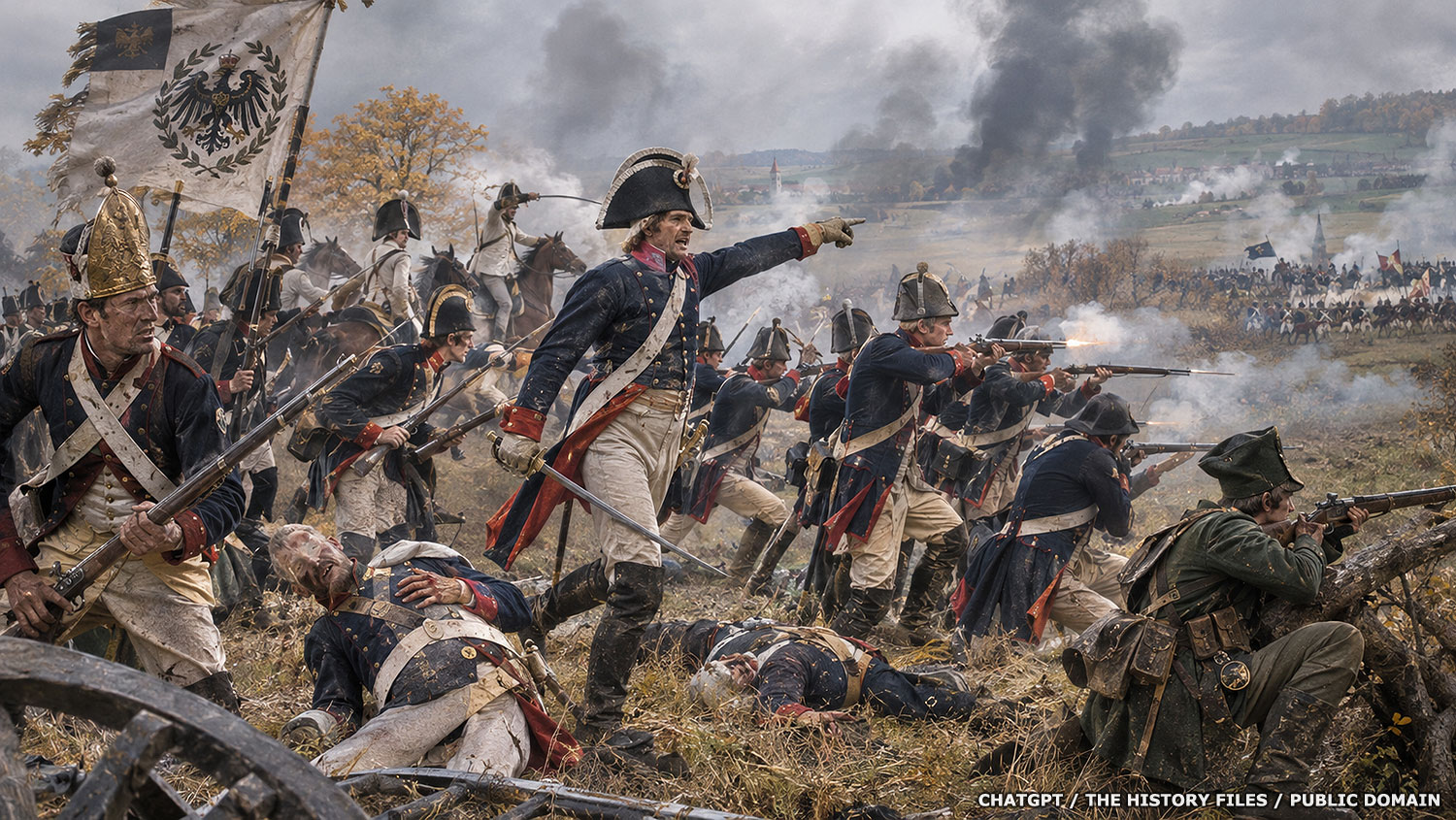
The Battle of Jena, 1806
During the mid-to-late seventeen hundreds, Frederick the Great's Prussian army stood as a formidable fighting machine and the pinnacle of European military power. Built on rigid Enlightenment rationalism, strict linear discipline, and legendary drill, this force had consistently routed its continental rivals. In the subsequent fifty years however, the army grew stagnant, viewing blind obedience as an end in itself rather than a flexible tool for warfare.
While Prussia rested on its past laurels, French military innovations under Napoleon Bonaparte completely transformed the European landscape, replacing static doctrines with fast-moving, massive independent army corps which lived off the land. The consequence of this widening tactical gap was a catastrophe which shocked Prussia to its core.
The twin battles of Jena and Auerstedt on 14 October 1806 shattered the myth of Prussian invincibility. Napoleon used rapid deployment and overwhelming numbers at Jena to crush the Prussian-Saxon alliance. Simultaneously at Auerstedt it was Marshal Davout's single corps which decisively routed the main Prussian army despite being outnumbered two to one.
The defeat triggered total panic and swift disintegration. The broken remnants of the Prussian army fled blindly into the night, and prestigious fortresses gave up without a fight, famously highlighted by the army surrendering Stettin to a mere eight hundred French troops.
With its territory halved by the subsequent Treaty of Tilsit in 1807, the state recognised the fact that the entire Prussian army had to be overhauled from the ground up. A military reorganisation commission was led by visionary reformers such as Gerhard von Scharnhorst and August von Gneisenau.
They discarded the outdated Frederickian system to birth a modern citizen-soldier model. They abolished brutal corporal punishment, opened officer commissions to non-nobles based on merit rather than birthright, and built a professional general staff to serve as an institutional brains trust.
By creating the Landwehr reserve system to tap into nationwide manpower, these changes rebuilt Prussia into an adaptive powerhouse which eventually was capable of helping to bring down Napoleon.
(This image offers a representative general depiction of the Battle of Jena in 1806, generated via AI for the History Files. AI works are public domain.)
Original text copyright © P L Kessler and the History Files. AI content is in the public domain. An original photo page for the History Files. Go back, return home, or go to the French First Empire page.